NOTICE & NEWS
EYEREUM OPHTHALMIC CLINIC
ESCRS 37TH CONGRESS OF THE ESCRS PARIS
OCULUS - PENTACAM Holladay Report
Dr. David S.Y. Kang Co-Authored ARVO 2026 Abstract on a New Centration Strategy for Refractive Correction
Research Overview
Meeting: 2026 ARVO Annual Meeting
Abstract: IOVS, June 2026 ARVO Abstracts Issue
Title: New Asymmetric Transition Zone Centration Strategy for Refractive Corrections: Theoretical Background and Preliminary Clinical Results
Co-authors: Shwetabh Verma, David Kang, Ivan Gabric, Victor Derhartunian, Samuel Arba Mosquera
Shwetabh Verma; David Kang; Ivan Gabric; Victor Derhartunian; Samuel Arba Mosquera Investigative Ophthalmology & Visual Science June 2026, Vol.67, 1211. doi: Purpose : To introduce a novel asymmetric transition zone (aTZ) centration strategy for Keratorefractive Lenticule Extraction (KLEx) procedures and evaluate its potential to compensate for fixation-related misalignments. Methods : The proposed method modifies correction profiles to account for both lateral and torsional fixation errors by decentering the optical zone (OZ) relative to the laser axis and employing an asymmetric crescent-shaped transition zone (aTZ) by defining the target pupil position, capturing the actual intraoperative pupil position, calculating deviations, and adapting the OZ and Transition Zone (TZ) geometries accordingly.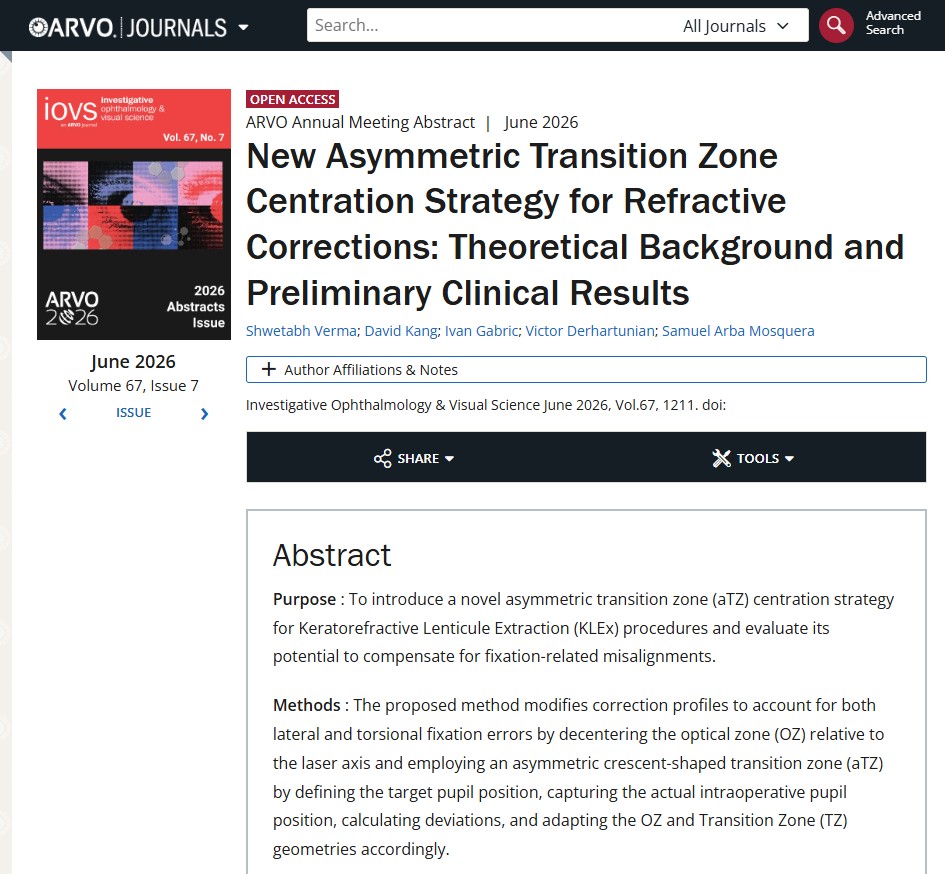
ARVO Annual Meeting Abstract | June 2026
New Asymmetric Transition Zone Centration Strategy for Refractive Corrections: Theoretical Background and Preliminary Clinical Results
Abstract
A study co-authored by Dr. David S.Y. Kang of Eyereum Eye Clinic was presented at the 2026 ARVO Annual Meeting in Denver, Colorado.
The study introduced a new asymmetric transition zone (aTZ) centration strategy for Keratorefractive Lenticule Extraction (KLEx), designed to account for lateral and torsional fixation-related misalignments.
The proposed strategy adjusts the optical and transition zones based on differences between the intended and actual pupil positions. Modeling results suggested its potential to compensate for fixation-related misalignments while preserving the central optical zone.
EYEREUM EYE CLINIC will continue to advance vision correction through ongoing clinical research and academic activities, with a focus on providing safe and precise patient care.