Treatment for keratoconus : Internationally acknowledged
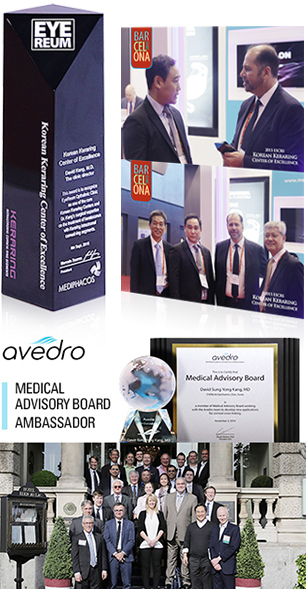
It is most important to treat as well as prevent any diseases. EYEREUM has been acknowledged for continually succeeding in the treatment of keratoconus and has been selected as Korea KERARING Center of Excellence by MEDIPHACOS Inc., an international medical company for keratoconus treatment ‘KERA-RING.’ Also, the Chief Director of EYEREUM, Dr. David Kang(David Sung Yong Kang) has been appointed as the only ambassador in Asia for the Avedro Medical Advisory Board, MAB, which consists of 15 world renowned medical specialists. He is working hand in hand with world leading specialists to establish a safety standard for the treatment and prevention of keratoconus. And EYEREUM is taking the initiative to acquire advanced medical technologies and provide them to patients in Korea.
Korean Keraring Center of Excellence
David Kang, M.D. The clinic director
This award is to recognize EyeReum Ophthalmic Clinic as one of the rare Korean Keraring Centers and Dr. Kang's surgical expertise on the treatment of keratoconus with Keraring intrastromal corneal ring segments.
8th Sept. 2015
Marcelo Soares, President
MEDIPHACOS
2015 ESCRS KOREAN KERARING CENTER OF EXCELLENCE
avedro MEDICAL ADVISORY BOARD AMBASSADOR
This is to Certify that Medical Advisory Board
David Sung Yong Kang, MD
EYEREUM Ophthalmic Clinic, Korea
is a member of Medical Advisory Board working with the Avedro team to develop new applications for corneal cross-linking.
November 2, 2014
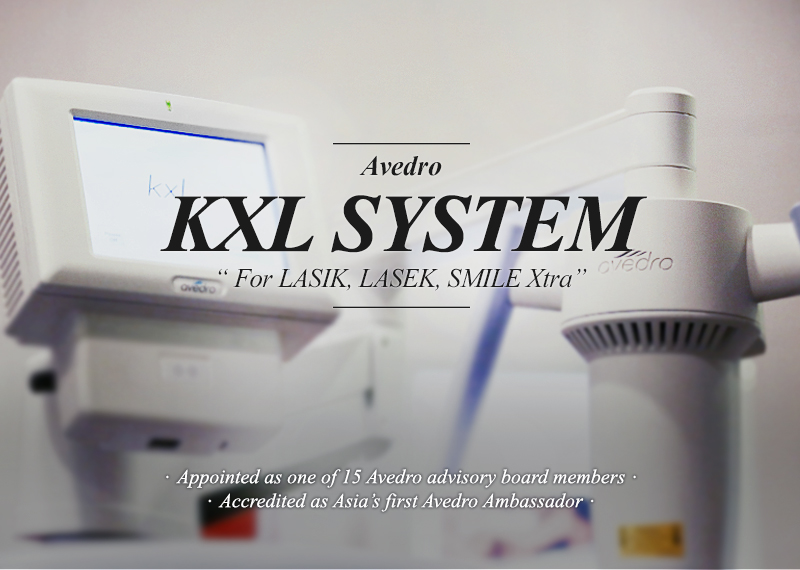
for LASIK·LASEK Xtra KXL SYSTEM
“Global Gold Standard”
Name
Affiliation
Rajesh K. Rajpal, MD
Walter Reed Army Medical Center
John Berdahl, MD
Vance Thompson, MD, FACS Univ. of S.Dakota
Roger F. Steinert, MD
The Gavin Herbert Eye Institute
Michael Gordon, MD
Gordon Binder Weiss Vision Institute
Daniel Durrie, MD
University of Kansas Medical Center
William J. Dupps. Jr, MD
Case Western Reserve University
Michael Mrochen, PhD.
Swiss Federal Institute of Technology (ETH)
Peter S. Hersh, MD, FACS.
Hersh Vision Group
Stephen L. Trokel, MD
New York, NY
J. Kanellolopoulos
NYU School of Medicine
David Sung-Yong Kang, MD
Eyereum Eye Clinic, Seoul
Accreditations
Appointed as one of 15 Avedro advisory board members
Accredited as Asia’s first Avedro Ambassador
Strengthening the post-surgially weakened cornea
Corneal Collagen Cross-linking: building a stronger cornea. LASIK, LASEK, Xtra® using the innovative KXL system enhances the bindings of corneal collagen molecules and adds strength to the cornea. It eliminates any side-effects and provides safety for patients with extreme myopia.
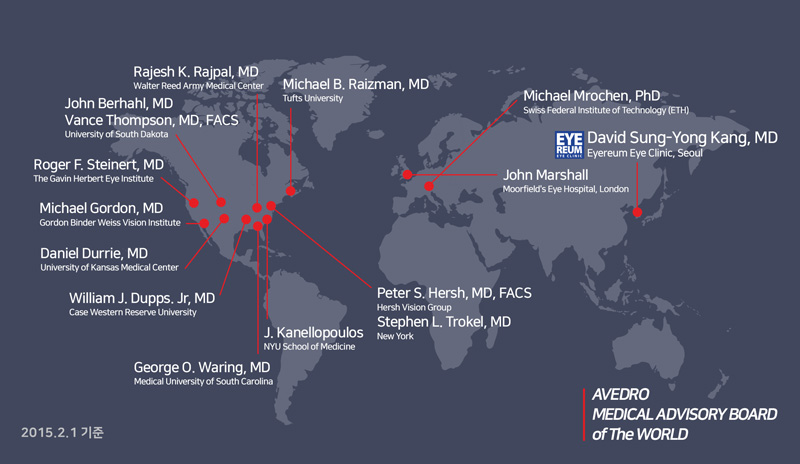
Avedro Medical Advisory Board
The MAB (Medical Advosiroy Board) members chosen by Avedro Inc. U.S.A. are comprised of ophthalmologic specialists from around the world. And each member is contributing to the development of new medical technologies with corneal cross-linking.
AVEDRO MEDICAL ADVISORY BOARD of The WORLD
2015.2.1 기준
Name
Affiliation
Rajesh K. Rajpal, MD
Walter Reed Army Medical Center
John Berhahl, MD
Vance Thompson, MD, FACS / University of South Dakota
Roger F. Steinert, MD
The Gavin Herbert Eye Institute
Michael Gordon, MD
Gordon Binder Weiss Vision Institute
Daniel Durrie, MD
University of Kansas Medical Center
William J. Dupps. Jr, MD
Case Western Reserve University
George O. Waring, MD
Medical University of South Carolina
Michael B. Raizman, MD
Tufts University
J. Kanellopoulos
NYU School of Medicine
Peter S. Hersh, MD, FACS
Hersh Vision Group
Stephen L. Trokel, MD
New York
Michael Mrochen, PhD
Swiss Federal Institute of Technology (ETH)
John Marshall
Moorfield's Eye Hospital, London
David Sung-Yong Kang, MD
Eyereum Eye Clinic, Seoul
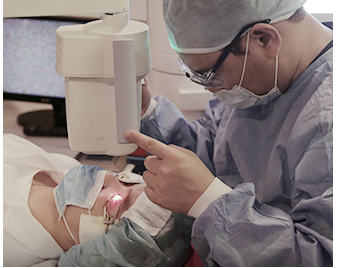
01 After undergoing the standard LASIK surgery, riboflavin (Vitamin B2) VibeX eye-drops are applied to the cornea and left to soak for 90 seconds.
02 The cornea is illuminated with 45mW/㎠ ultra violet light for 90 seconds using the KXL system.
03 Biomechanical strength is added to the cornea, strengthening the collagen binding.
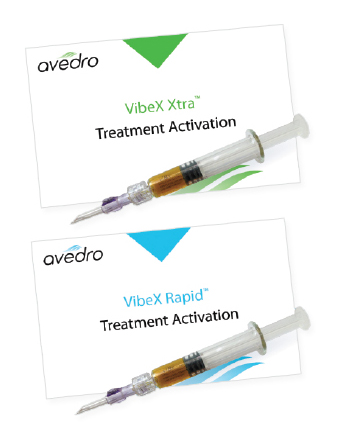
Brand
Product Name
Description
avedro
VibeX Xtra™
Treatment Activation
avedro
VibeX Rapid™
Treatment Activation
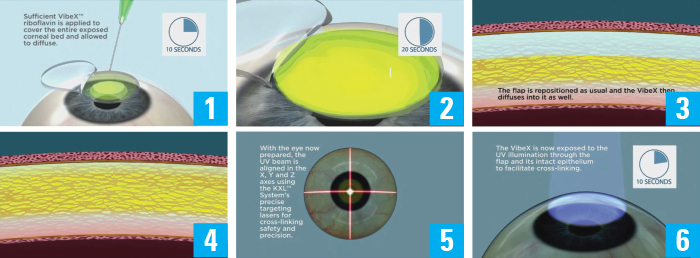
Step Number
Description
Duration
1
Sufficient VibeX™ riboflavin is applied to cover the entire exposed corneal bed and allowed to diffuse.
10 SECONDS
2
20 SECONDS
3
The flap is repositioned as usual and the VibeX then diffuses into it as well.
4
5
With the eye now prepared, the UV beam is aligned in the X, Y and Z axes using the KXL™ System's precise targeting lasers for cross-linking safety and precision.
6
The VibeX is now exposed to the UV illumination through the flap and its intact epithelium to facilitate cross-linking.
10 SECONDS
01 QUICK
Compared to the standard cross-linking procedure, KXL system has radically reduced surgical time.
02 SAFE
Eliminated side effects such as dry-eyes and corneal opacity.
03 DETAIL
Bind more collagens by using not the standard continuous energy method but the High Fluence-Pulsed Energy method.
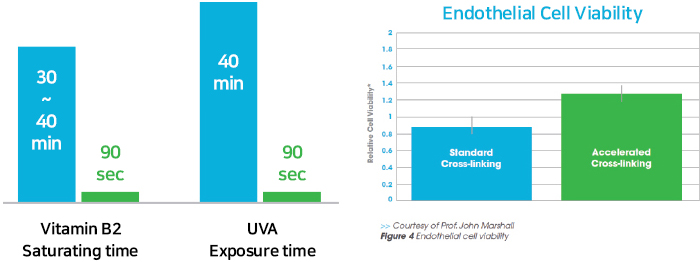
Vitamin B2 Saturating time and UVA Exposure time Comparison
Category
Standard Method
Accelerated Method
Vitamin B2 Saturating time
30 ~ 40 min
90 sec
UVA Exposure time
40 min
90 sec
Endothelial Cell Viability
Method
Relative Cell Viability*
Standard Cross-linking
~0.88
Accelerated Cross-linking
~1.28
>> Courtesy of Prof. John Marshall
Figure 4 Endothelial cell viability
Already more than 100,000 surgeries performed over the World. 100,000 Cross-linking surgeries have already been performed in the world. It is a procedure that has been used to treat keratoconus for the past 10 years. As patients who have undergone the cross-linking procedure after their LASIK or LASEK surgery have shown a stable vision as well as no signs of myopia regression or keratoconus.
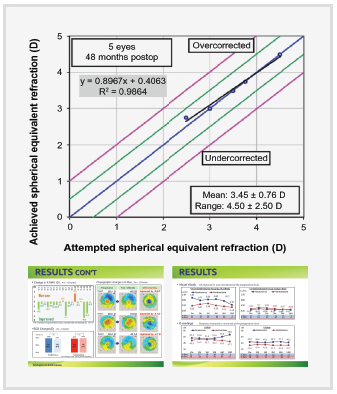
Achieved vs Attempted spherical equivalent refraction (D)
Sample Size
5 eyes
Follow-up
48 months postop
Regression Equation
y = 0.8967x + 0.4063
R-squared
R² = 0.9864
Mean Achieved
3.45 ± 0.76 D
Range
4.50 ± 2.50 D
Attempted spherical equivalent refraction (D)
Achieved spherical equivalent refraction (D)
Status
~2.6
~2.7
Overcorrected
~3.0
~3.0
On target
~3.4
~3.4
On target
~3.7
~3.7
On target
~4.5
~4.5
On target
RESULTS CON'T
Key Findings
Change in K-MAX (D), N=10 eyes
Topographic change in K-Max, N=10 eyes
BGI (Belin/Ambrósio Enhanced Ectasia Display) index change
RESULTS
Clinical Outcomes
Visual Acuity: UDVA maintained or improved compared to preoperative level
K-readings: Steepness improved or remained stable compared to preoperative level
Comparison of The Standard Cross-linking Procedure and The KXL System
-
KXL System
Standard Cross-linking Procedure
UVA exposure method
High Fluence Pulsed Energy
Continuous Energy
Vitamin B2 saturation time
90 sec.
about 30~40 minutes
UVA exposure time
90 sec.
about 40 minutes
Features
Can bind more collagens in a short amount of time.