SmartPulse Technology
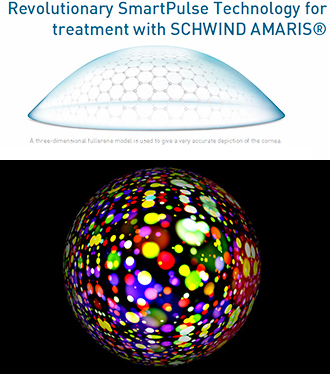
Smart Pulse Technology (SPT) is a three-dimensional laser algorithm which optimizes the smoothness of the corneal surface to improve vision quality. This three dimensional model describes the curvature of the cornea, and the fullerene structure makes it possible to position the pulses more closely than ever before. This innovative technology leads to not only a faster recovery and a greater vision quality but also reduces possible recovery pain and HOA.
Revolutionary SmartPulse Technology for treatment with SCHWIND AMARIS®
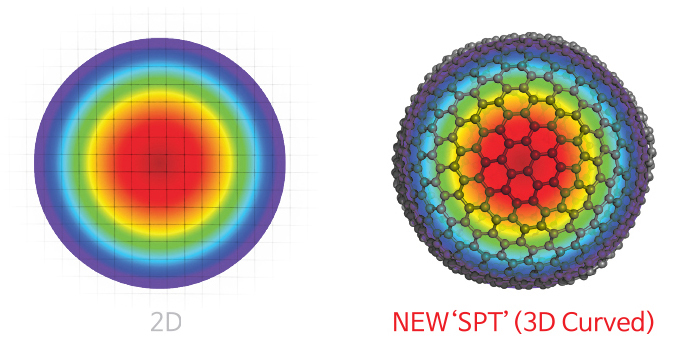
A three-dimensional fullerene model is used to give a very accurate depiction of the cornea.
EYEREUM Eye Clinic & 7 International research centers
Name
Location
David T Lin
@ Vancouver, Canada
Michiel HA Luger
@ Utrecht, The Nether Lands
Diego de Ortueta
@ Recklinghausen, Germany
Paolo Vinciguerra
@ Milano, Italy
Shady T Awwad
@ Beirut, Lebanon
David Sung-Yong Kang
@ Seoul, Korea
Maria C Arbelaez
@ Muscat, Oman
Jerry Tan
@ Singapore
Proven effectiveness with more than 1,000 procedures
8 clinics in 8 different countries, including Italy, Germany, the Netherlands, Canada, and Singapore, were chosen as AMARIS SPT official centers, and participated in the SPT development project to prove the effectiveness through more than 1,000 surgeries. EYEREUM’s chief director, Dr. David Kang(David Sung Yong Kang), was the only one given the honor of participating in this project in Korea.
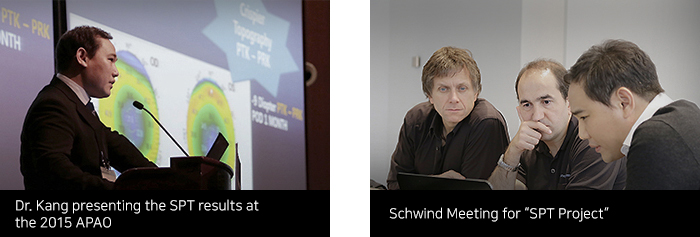
Dr. Kang presenting the SPT result at the 2015 APAO
Schwind Meeting for "SPT Project"
Presentation Slide Content
PTK - PRK
Crispier Topography PTK - PRK
-9 Diopter PTK - PRK POD 1 MONTH
The "world's first"
Three dimensional laser algorithm which accurately depicts the cornea
SPT uses a sophisticated geometric model based on a fullerene structure. This three dimensional model depicts the curvature of the cornea very realistically, and the fullerene structure makes it possible to position the pulses more closely than ever before. This is particularly marked at the periphery of the cornea. The totality of this innovation results in a very smooth corneal surface.
Type
Description
2D
Visual representation of a flat circular gradient
NEW ‘SPT’ (3D Curved)
Visual representation of a spherical hexagonal lattice structure with gradient
Why Does the Cornea Surface Have to Be Smooth?
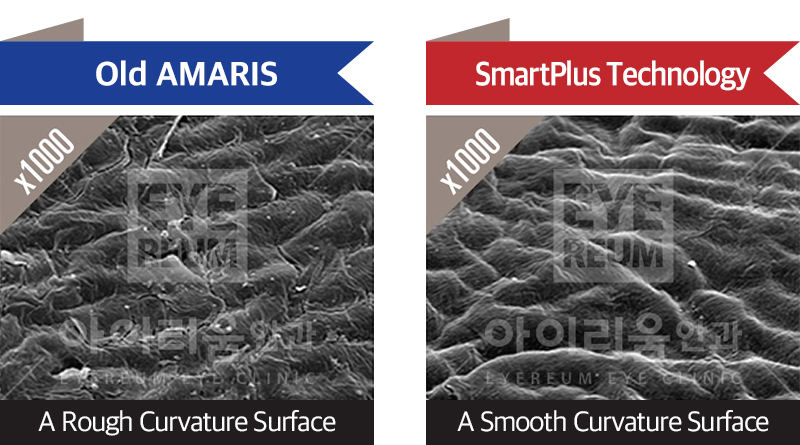
Just like the surface of eye glasses needs to be smooth for a clear vision, it is obvious that the surface of our cornea needs to be smooth as well for a greater vision quality. After a standard laser eye surgery, the cornea surface is left rough or even rugged. However the AMARIS SPT optimizes the smoothness of the cornea surface, resulting in a clear vision even right after surgery. The effectiveness of SPT is best seen in LASEK surgeries where the corneal surface is ablated. When comparing the level of corneal surface roughness, patients who underwent the standard laser surgery had an average roughness of 749nm, whilst those who had the SPT procedure had an average roughness of 272nm, thus SPT reduces the roughness to almost 1/3. (Sept. 2014 ESCRS, Paola, Italy)
Technology
Magnification
Surface Description
Old AMARIS
x1000
A Rough Curvature Surface
SmartPulse Technology
x1000
A Smooth Curvature Surface
ⓒ All rights reserved. EYEREUM & Yonsei University Severence Hospital, The comparison between the cornea surface after other laser surgery
SmartPulse Technology
"Wow Effects!"
Method
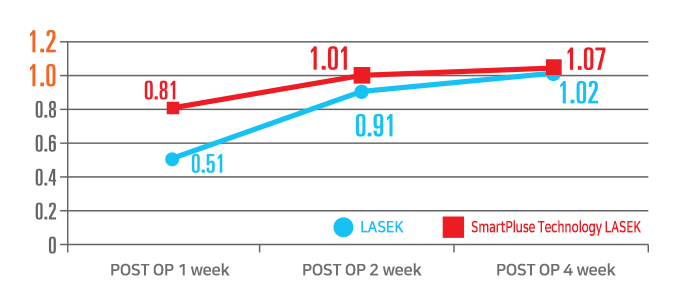
POST OP 1 week
POST OP 2 week
POST OP 4 week
SmartPluse Technology LASEK
0.81
1.01
1.07
LASEK
0.51
0.91
1.02
Clinical test results from the 8 SPT official research centers showed that SPT smoothed the cornea surface, innovatively improving vision quality, reducing recovery time and pain, and effectively preventing blurred vision. EYEREUM, one of SPT official research centers, performed LASEK surgery with SPT on patients with an average -7D. Within a week after the surgery, the patients’ recovery was 1.6 times quicker than those who just had standard LASEK procedures, and after 2 weeks those patients reached a 20/20 vision.
Effects of AMARIS RED Smart Pulse Technology (SPT)
Optimizes the smoothness of the rough and rugged cornea surface.
Faster recovery as corneal epithelium reproduction is quicker. Less pain. An average 20/20 vision within 2 weeks.
Successfully completing 31,000 surgeries with SPT and CoWave, which were tailored to the precise optics of the eye.
AMARIS RED
Making New History
The Schwind AMARIS RED 1050RS is an innovative laser which delivers an unsurpassed repetition rate of 1050 HZ – currently the highest of all excimer lasers on the market – and an active 7D eye tracker. The new, ground-breaking Latency Free Tracking considers the time factor, the 7th dimension. Latency Free Tracking compensates for eye movements that occur in the period between acquisition of the eye tracker image and triggering of the subsequent laser pulses.
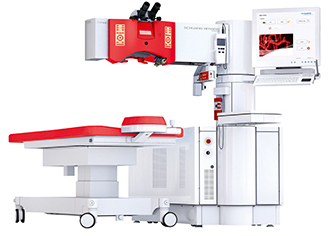
SCHWIND AMARIS 1050RS
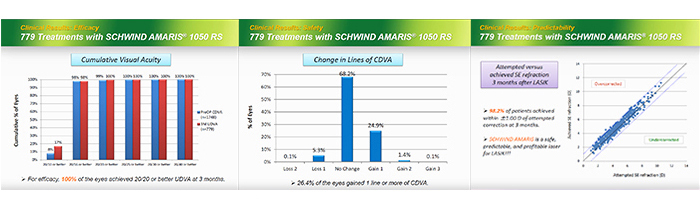
According to Shinagawa LASIK Center, the largest ophthalmology in Japan, all the 886 patients who underwent surgery with AMRAIS RED 1050RS reached a 20/20 vision within 3 months. This result proves as well as commemorates the successful effectiveness of AMARIS RED 1050RS.
Attempted versus achieved SE refraction 3 months after LASIK
98.2% of patients achieved within ±1.00 D of attempted correction at 3 months.
SCHWIND AMARIS is a safe, predictable, and profitable laser for LASIK!!!
Attempted SE refraction (D)
Achieved SE refraction (D)
0
0
2
2
4
4
6
6
8
8
10
10
12
12
14
14
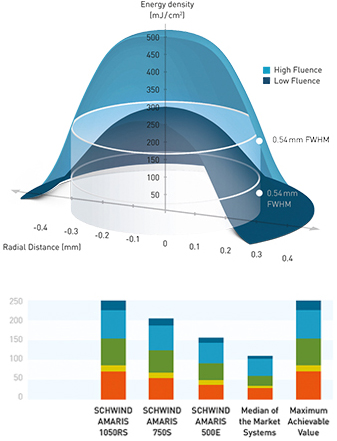
01AMARIS RED 1050RS delivers an extremely short ablation time of just 103 seconds per diopter at an unsurpassed repetition rate of 1050HZ.
02AMARIS RED 1050RS thermal control process prevents damages to the surrounding corneal tissue, even at a very high ablation speed.
03AMRAIS RED 1050RS flying spot system achieves an exceptionally small ablation available.
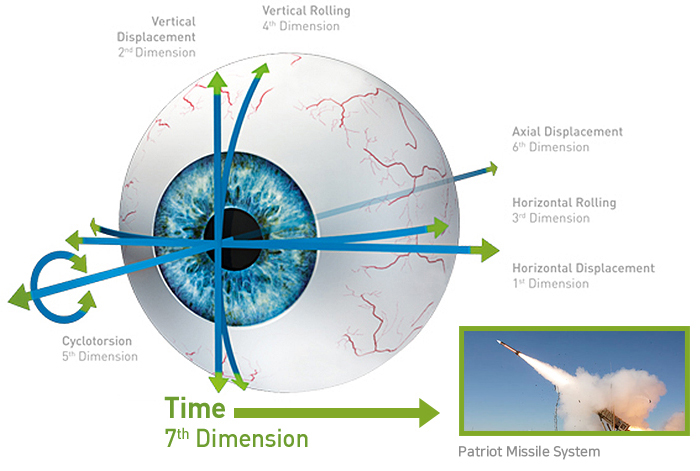
Eye Tracking Dimensions
Dimension
Movement Type
1st Dimension
Horizontal Displacement
2nd Dimension
Vertical Displacement
3rd Dimension
Horizontal Rolling
4th Dimension
Vertical Rolling
5th Dimension
Cyclotorsion
6th Dimension
Axial Displacement
7th Dimension
Time
Patriot Missile System
The new, ground-breaking Latency-Free Tracking considers the time factor, i.e. the 7th dimension. Latency-Free Tracking compensates for eye movements that occur in the period between acquisition of the eyetracker image and triggering of the subsequent laser pulses.
01 QUICK
The shortest ablation time currently existing, reducing thermal corneal damage and ablation area
02 SAFE
Active 7D eye tracking means that the Schwind AMARIS RED 1050RS combines space and time without latency time and can know the new target position in advance
03 DETAIL
HOA is reduced by approximately 18% with the CoWave system and stabilizes and improves vision quality
01Latency Free Tracking in the 7th dimension
021050HZ pulse rate – fastest of all lasers
03Intelligent Thermal Effect Control prevents corneal tissue damage
04Flying-spot system – smallest ablation area
05Monitors pupil center and measures precise corneal thickness throughout the entire treatment
06Corneal Wavefront system – reducing HOA by 18%
07Improves vision quality with SCC mode
08Transepithelial single-step treatment avoiding any outer interference
Corneal Wavefront Guided :
The Answer to Blurred Vision
Schiwind AMARIS Inc. appointed EYEREUM as Asia-Pacific official research center in 2011 mainly due to our Co-Wave technology. Co-Wave, Corneal Wavefront, eliminates the possibility of HOA after surgery by more than 38% (presented by EYEREUM chief director Dr. David Kang(David Sung Yong Kang) at the 2015. 9 ESCRS) and surprisingly reduced night blurred vision. In short, Co-Wave is an advanced tailored surgery customized to each person’s eye.
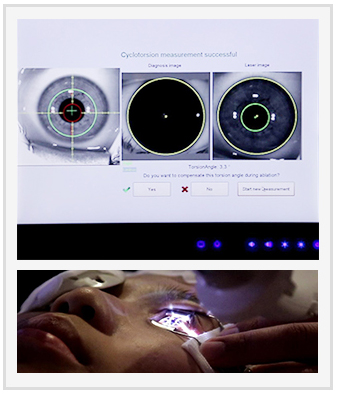
Cyclotorsion measurement successful
Image Type
Visual Data
Diagnosis Image
[Eye scan with yellow circular overlay]
Laser Image
[Eye scan with yellow and green circular overlays]
TorsionAngle
3.3 °
Do you want to compensate this torsion angle during ablation?
User Options
Yes
No
Start new Q-measurement
Comparison with Other Lasers
-
AMARIS 1050RS
Other Laser
Laser ablation speed
1050 Hz
20 Hz ~ 500 Hz
Laser beam size
0.54 mm
0.68 mm ~ 2 mm
Laser beam size when reaching the cornea
0.54 mm
More than 0.95 mm (the size of the laser beam and the size of the beam when reaching the cornea is different)
Time per dipter
1.3 seconds
More than 2 seconds
Eye-tracking method
7-Dimensional (X, Y, Z, X Rotation, Y Rotation, Static Cyclo Torsion, Dynamic Cyclo Torsion, Time)
6 Dimensional (X, Y, Static Cyclo Torsion)
Eye-tracking time
1050 Hz
Below 1050 Hz
Time difference between eye-tracking and laser ablation time