The Zeiss VisuMax laser is the only laser in the world that can perform ReLEx SMILE. VisuMaz uses femtosecond lasers to produce extremely short pulses of laser light which are used to divide corneal tissue layers. To minimizes corneal damage,
011.5~4.5µm Laser.
02 Low Energy < 200nJ
03 500kHz laser pulse frequency is used.
Step Description
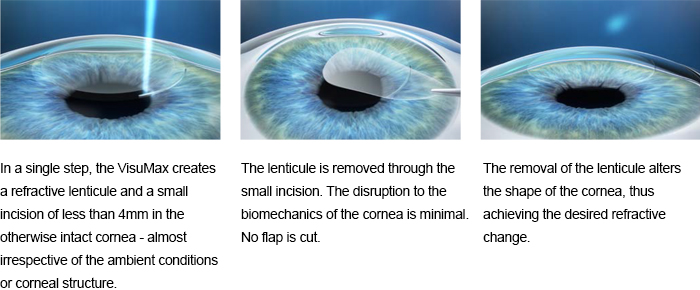
In a single step, the VisuMax Creates a refractive lenticule and a small incision of less than 4mm in the otherwise intact cornea - almost irrespective of the ambient conditions or corneal structure.
The lenticule is removed through the small incision. The disruption to the biomechanics of the cornea is minimal. No flap is cut.
The removal of the lenticule alters the shape of the cornea, thus achieving the desired refractive chane.
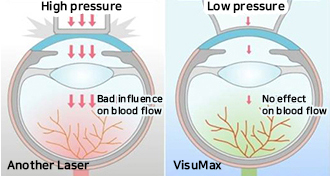
Standard femtosecond lasers applied high pressure on the cornea after creating problems like corneal bleeding. However, VisuMax has reduced the pressure, eradicating side effects such as corneal bleeding or dry-eyes.
Laser Type
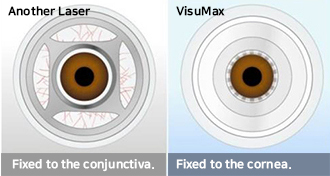
Fixation Method
Another Laser
Fixed to the conjunctiva.
VisuMax
Fixed to the cornea.
The human cornea is curved. Thus, Carl Zeiss contact glasses are curved way, too. The three different sizes available (S, M, L) ensure an optimal t to the anatomy of the eye.
Category
Another Laser
VisuMax
Pressure Level
High pressure
Low pressure
Effect on Blood Flow
Bad influence on blood flow
No effect on blood flow
The cornea is not forced into a deformed planar, non-physiologi- cal shape – and artifacts are avoided in the cutting result, as is unnecessarily high IOP.
Precise Centering
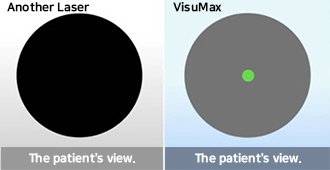
During surgery when the patient is lying down, the laser’s fixation point accurately locates the centering, performing an ideal visual correction surgery.
Laser Type
Visual Representation
Caption
Another Laser
Solid black circle
The patient's view.
VisuMax
Grey circle with a green dot in the center
The patient's view.
Measuring the Volume of Space
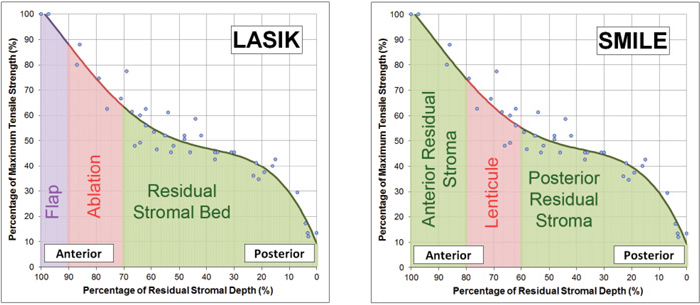
There is no cutting or burning of corneal tissue during the ReLEx SMILE procedure. The laser breaks down the molecular bonds in the cornea without causing any collateral damage. As the cornea should be understood as space volume, it is necessary to assiduously comprehend the cornea volume before surgery and the volume of the extracted lenticule. This enables to design a complete tailored surgery to maximize corneal strength and prevent any side effects such as keratoconus.
LASIK
Percentage of Residual Stromal Depth (%)
Percentage of Maximum Tensile Strength (%)
Zone Label
100 to 90
100 to ~88
Flap (Anterior)
90 to 70
~88 to ~64
Ablation
70 to 0
~64 to ~10
Residual Stromal Bed (Posterior)
SMILE
Percentage of Residual Stromal Depth (%)
Percentage of Maximum Tensile Strength (%)
Zone Label
100 to 80
100 to ~75
Anterior Residual Stroma (Anterior)
80 to 60
~75 to ~56
Lenticule
60 to 0
~56 to ~10
Posterior Residual Stroma (Posterior)
Chart Axis Labels
Y-axis: Percentage of Maximum Tensile Strength (%)
X-axis: Percentage of Residual Stromal Depth (%)
The relationship between the removed cornea and the corneal stiffness during LASIK SMILE / From a thesis written by Dr. Dan Reinstein
360,000 surgeries worldwide. Safety of SMILE.
Based on Jan. 2016.
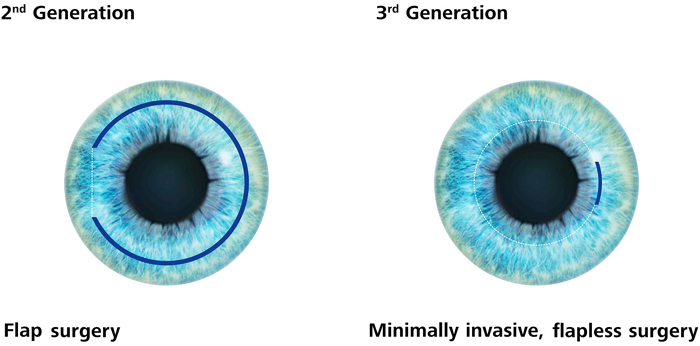
First started in 2006, the intra-stromal lenticule extraction of SMILE is called the 3rd generation or the next generation of laser vision correction. According to Zeiss, this femtosecond lenticule extraction method has been successfully performed 360,000 times up to Jan. 2016 all over the world including Europe.
Generation
Surgery Type
2nd Generation
Flap surgery
3rd Generation
Minimally invasive, flapless surgery
Post-SMILE operative pain and recovery time
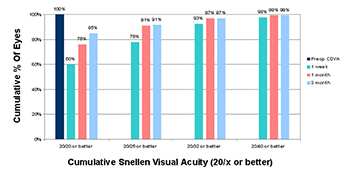
SMILE causes little damage to the cornea, so it is possible to wash your face, use basic skin care products, and do light exercises the following day. Also, 70% of patients reached a 20/20 vision the next day, and it took the other 30% 3~7 days. However, some patients have experienced a slight Blurry vision for about 1~2 weeks. To reduce this side effect, it is absolutely crucial to undergo the procedure from a verified specialist.