[논문] 로우에너지 스마일라식 효과, 두 번째 SCI 논문 발표
아이리움안과 '로우에너지 스마일라식' 연구논문이
AJO(American Journal of Ophthalmology)에 이어
SCI 학술지인 JRS(Journal of Refractive Surgery)에 등재됐습니다.
Effect of Lowering Laser Energy on the Surface Roughness of Human Corneal Lenticules in SMILE
<2017>
▼'각막 렌티큘 표면에 미치는 로우에너지 스마일의 우수한 효과' JRS 수록
Yong Woo Ji, MD; Minseo Kim; David Sung Yong Kang, MD; Dan Z. Reinstein, MD, MA(Cantab), FRCSC; Timothy J. Archer, PhD; Jin Young Choi, MD; Eung Kweon Kim, MD, PhD; Hyung Keun Lee, MD, PhD; Kyoung Yul Seo, MD, PhD; Tae-im Kim, MD, PhD PURPOSE: To determine the effect of lowering femtosecond laser energy on the surface quality of the intrastromal interface during small incision lenticule extraction (SMILE). METHODS: Forty age- and diopter-matched female patients (40 eyes) with moderate myopia received SMILE with different energy levels (100 to 150 nJ) and fixed spot separation (4.5 μm). Five human corneal lenticules from each energy group were evaluated by atomic force microscopy and scanning electron microscopy (SEM). Both anterior and posterior surface characteristics of the lenticules were assessed. RESULTS: All measurements of surface roughness were approximately three times higher and in the anterior and posterior surface of the lenticules with the energy level of 150 nJ than with 100 nJ (P < .001). Furthermore, atomic force microscopy analysis found that energy differences of 15 nJ or more made a significant difference in surface roughness at energy levels of 115 nJ or higher. Interestingly, there was no significant difference in all roughness values of both surfaces among the 100, 105, and 110 nJ groups. In addition, all values of surface roughness were significantly positively correlated with laser energy for both anterior and posterior surfaces of the lenticule (P < .001). Consistent with atomic force microscopy results, SEM also showed that the SMILE lenticules in the higher laser energy group had more irregular surfaces. CONCLUSIONS: Lowering laser energy levels can improve surface quality of the lenticule of SMILE. To achieve better visual outcomes with faster recovery after the procedure, it is recommended to reduce the laser energy to less than 115 nJ at a spot separation of 4.5 μm. [J Refract Surg. 2017;33(9):617-624.] Small incision lenticule extraction (SMILE) is the latest refractive surgical technique using only a femtosecond laser, which removes the corneal stromal lenticule through a small corneal incision ranging from 2 to 5 mm.1,2 This procedure could be achieved by using a femtosecond laser platform with higher firing frequency. Recently, the 500-kHz VisuMax (Carl Zeiss Meditec AG, Jena, Germany) platform with a pulse energy of 115 to 170 nJ has been used.1,3,4 Several studies have reported comparable or superior efficacy, predictability, and safety to other refractive surgery techniques, including femtosecond lenticule extraction (FLEx).4-7 However, SMILE still has an unresolved issue of slow recovery of visual acuity in the early postoperative period.8-10 It is well known that a smooth and regular optical interface surface is essential for visual acuity after any kind of corneal refractive surgery.11-13 Furthermore, some studies have reported that the surface regularity of the human corneal lenticule and posterior stroma depends on the energy settings.14-16 A recent From the Institute of Vision Research (YWJ, EKK, HKL, KYS, TK) and Corneal Dystrophy Research Institute (YWJ, EKK, HKL, KYS, TK), Department of Ophthalmology, Yonsei University College of Medicine, Seoul, South Korea; Hankuk Academy of Foreign Studies, Yongin, South Korea (MK); Eyereum Eye Clinic, Seoul, South Korea (DSYK, JYC); London Vision Clinic, London, United Kingdom (DZR, TJA); the Department of Ophthalmology, Columbia University Medical Center, New York (DZR); Centre Hospitalier National d'Ophtalmologie, Paris, France (DZR); and Biomedical Science Research Institute, University of Ulster, Coleraine, Northern Ireland (DZR, TJA). Submitted: March 11, 2017; Accepted: May 26, 2017 Supported by Basic Science Research Program through the National Research Foundation of Korea (NRF) funded by the Ministry of Education, Science and Technology (NRF-2016R1A2B4009626). Dr. Reinstein is a consultant for Carl Zeiss Meditec (Carl Zeiss Meditec AG, Jena, Germany) and has a proprietary interest in the Artemis technology (ArcScan, Inc., Golden, Colorado) through patents administered by the Center for Technology Licensing at Cornell University (CTL), Ithaca, New York. The remaining authors have no proprietary or financial interest in the materials presented herein. Correspondence: Tae-im Kim, MD, PhD, Department of Ophthalmology, Yonsei University College of Medicine, 50-1 Yonsei-ro, Seodaemun-gu, Seoul 03722, Korea. E-mail: tikim@yuhs.ac doi:10.3928/1081597X-20170820-02 Journal of Refractive Surgery • Vol. 33, No. 9, 2017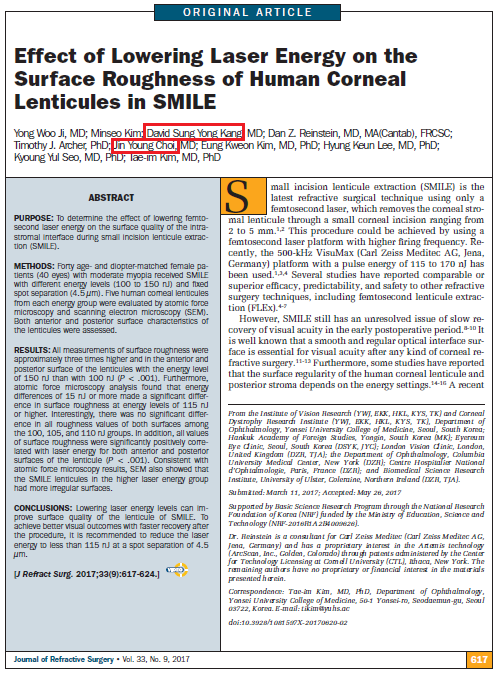
ORIGINAL ARTICLE
Effect of Lowering Laser Energy on the Surface Roughness of Human Corneal Lenticules in SMILE
ABSTRACT
스마일라식은 펨토세컨레이저를 이용해 2mm의 각막 절개창을 통해
렌티큘(각막실질조사)를 제거하는 최신 시력교정술입니다.
아이리움안과 강성용, 최진영 원장은 스마일라식 수술 시
'에너지 셋팅이각막표면에 미치는 영향'에 대한 연구를 진행해
에너지 세기가 낮을수록 렌티큘 표면을 매끄럽게 만들어
시력회복을 높인다는 것을 규명했습니다.
(A) The lenticule obtained from small incision lenticule extraction (SMILE) using conventional femtosecond laser energy (140 and 150 nJ) with a spot separation of 4.5 μm had a more irregular surface than that from SMILE using low energy (100 and 110 nJ) with the same spot separation on both the anterior and posterior surfaces. The posterior surface of the SMILE lenticule was rougher than the anterior surface at each energy level (× 300). (B) The cavitation bubbles were observed at the periphery of both surfaces of the lenticules from SMILE using laser energy of more than 120 nJ (× 300).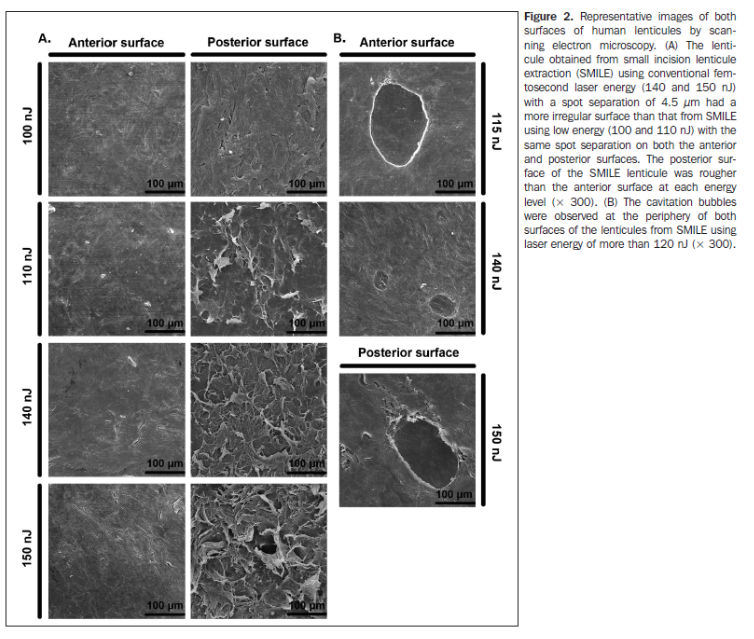
Figure 2. Representative images of both surfaces of human lenticules by scanning electron microscopy.
Section Energy Level Anterior surface Posterior surface A. 100 nJ 100 μm scale image 100 μm scale image A. 110 nJ 100 μm scale image 100 μm scale image A. 140 nJ 100 μm scale image 100 μm scale image A. 150 nJ 100 μm scale image 100 μm scale image B. 115 nJ 100 μm scale image B. 140 nJ 100 μm scale image B. 150 nJ 100 μm scale image
아이리움안과 의료팀의 연구논문에 따르면
에너지세기 150nJ로 수술하면 100nJ로 수술했을 때보다
렌티큘 표면이 3배 더 거칠었으며
특히 원자력 현미경과 전자 현미경 분석결과
115nJ 이상 높은 에너지로 갈수록 에너지가 15nJ씩 높아질때 마다
렌티큘 전∙후면부 모두 표면이 더욱 거칠고 불규칙해지며
반면 100, 105, 110nJ 저에너지 그룹에선
렌티큘 표면 거칠기에 큰
차이가 없었습니다.
스마일라식은 라식과 라섹의 장점을 합쳐놓은 수술로
최근 많은 사람들이 선호하고 있지만
수술 초기 느린 시력회복은 개선점으로 지적됐는데요.
115nJ에 이하 에너지를 적용하면 빠른 시력회복과 함께
시력의 질을 높일 수 있습니다.
물론 각기 다른 눈 조건에 따라 적합한 에너지에 차이가 있습니다.
국내 최초로 ‘로우에너지 스마일라식’을 시행한 아이리움안과는
에너지 세기라는 또 다른
안전기준을 제시하며 스마일라식의 지평을 넓히고 있습니다.
각막손상 최소화, 빠른 회복, 시력의 질 향상!
과학적으로 검증 받은 뛰어난 연구성과로 더욱 안전하고 만족도 높은
시력교정술을 실현하는 아이리움안과가
되겠습니다.