NOTICE & NEWS
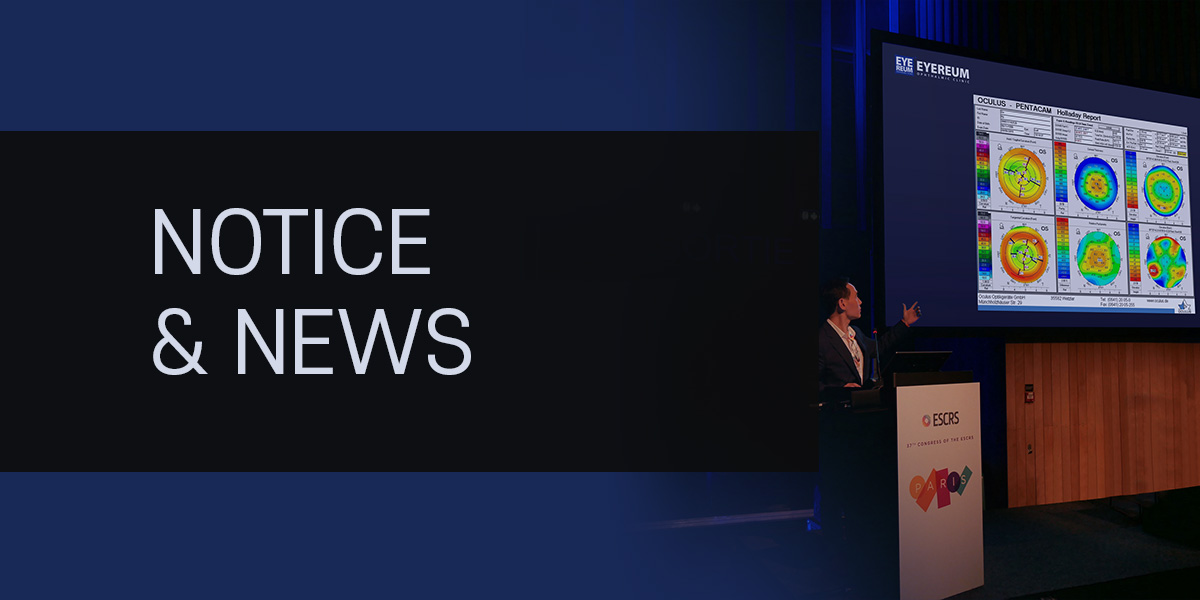
EYEREUM OPHTHALMIC CLINIC
ESCRS 37TH CONGRESS OF THE ESCRS PARIS
OCULUS - PENTACAM Holladay Report
[Paper] New paper about SMILE treatment is published on JRS!
Hun Lee, MD; David Sung Yong Kang, MD; Dan Z. Reinstein, MD; Cynthia J. Roberts, PhD; Renato Ambrósio Jr, MD, PhD; Timothy J. Archer, PhD; Seung Ki Jean, MR; Eung Kweon Kim, MD, PhD; Kyoung Yul Seo, MD, PhD; Ikhyun Jun, MD, PhD; Tae-im Kim, MD, PhD Journal of Refractive Surgery. 2019;35(3):153-160 https://doi.org/10.3928/1081597X-20190205-01 Posted March 11, 2019 PURPOSE: To evaluate the amount of spherical equivalent correction for three different cap thicknesses (120, 130, and 140 μm) during myopic small incision lenticule extraction (SMILE) and determine the association between the amount of spherical equivalent correction and several variables in each cap thickness group. METHODS: In this retrospective, comparative, observational case series study, the authors compared refractive errors, keratometric values, laser setting (sphere correction, cylinder correction, spherical equivalent correction, optical zone, and cap diameter), and spherical aberration measured preoperatively and at 3 months postoperatively between three different cap thickness groups: 120 μm (n = 554), 130 μm (n = 377), and 140 μm (n = 90). Multiple linear regression analyses were used to determine the associations between the amount of spherical equivalent correction and several variables, including age, preoperative spherical equivalent, optical zone diameter, central corneal thickness, preoperative mean keratometric values, and preoperative corneal asphericity.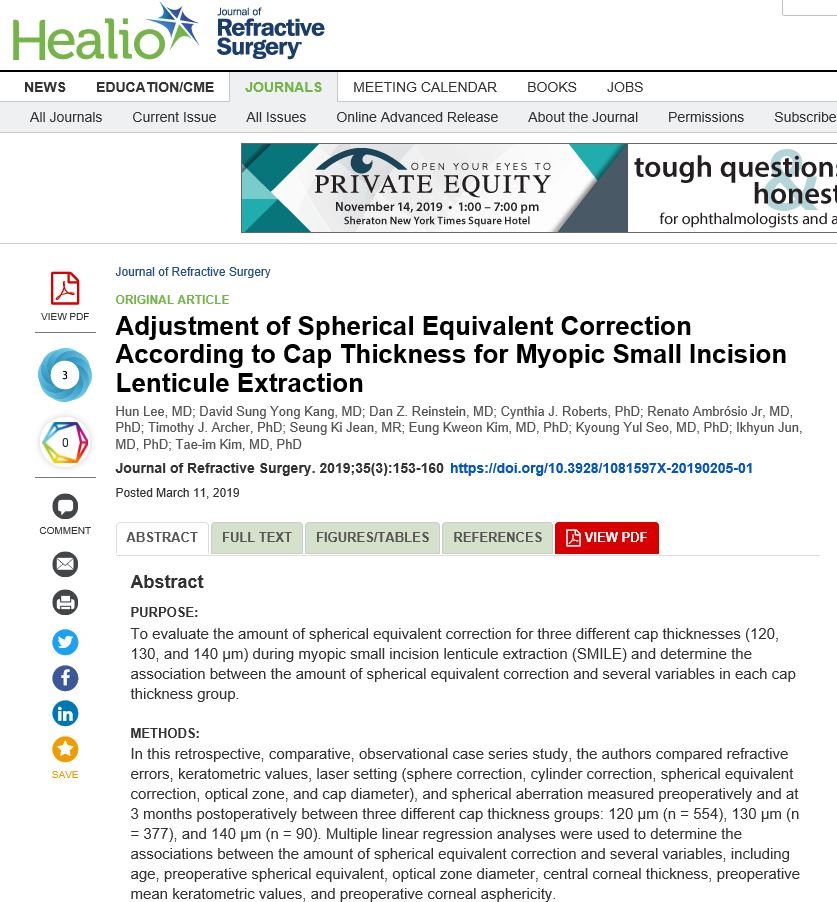
Journal of Refractive Surgery
ORIGINAL ARTICLE
Adjustment of Spherical Equivalent Correction According to Cap Thickness for Myopic Small Incision Lenticule Extraction
Abstract