
NOTICE & NEWS
EYEREUM OPHTHALMIC CLINIC
ESCRS 37TH CONGRESS OF THE ESCRS PARIS
OCULUS - PENTACAM Holladay Report
[Paper] Effect of Corneal Cross-linking After Transepithelial Photorefractive Keratectomy
A new paper was published in the JRS.
"Effect of Corneal Cross-linking on Epithelial Hyperplasia and Myopia Regression After Transepithelial Photorefractive Keratectomy"
Journal of Refractive Surgery David Sung Yong Kang, MD; Sun Woong Kim, MD, PhD PURPOSE: To investigate the effect of accelerated corneal cross-linking (CXL) on epithelial thickness change and refractive outcome after myopic transepithelial photorefractive keratectomy (TPRK). METHODS: This study compared epithelial thickness changes in 49 patients undergoing TPRK-CXL with 49 patients undergoing TPRK who were matched for age and refractive error. Corneal epithelial thickness, obtained using spectral-domain optical coherence tomography preoperatively and 12 months postoperatively, was compared between the groups. Regression analysis was performed to investigate the association between changes in epithelial thickness and keratometric power. Factors affecting myopic regression (> 0.50 diopters] were evaluated using logistic regression analysis.
Healio Journal of Refractive Surgery
Navigation Menu
Journal Sub-navigation
ORIGINAL ARTICLE SUPPLEMENTAL DATA
Effect of Corneal Cross-linking on Epithelial Hyperplasia and Myopia Regression After Transepithelial Photorefractive Keratectomy
Article Tabs
Abstract
More details are here>> https://doi.org/10.3928/1081597X-20190422-01
(A) TPRK induced epithelial thickening over a 6-mm diameter area, with the most thickening occurring in the temporal paracentral area (2- to 5-mm zone). (B) Concurrent CXL induced less thickening in the central (P = .013) and paracentral (overall P = .063, *< .05) sectors.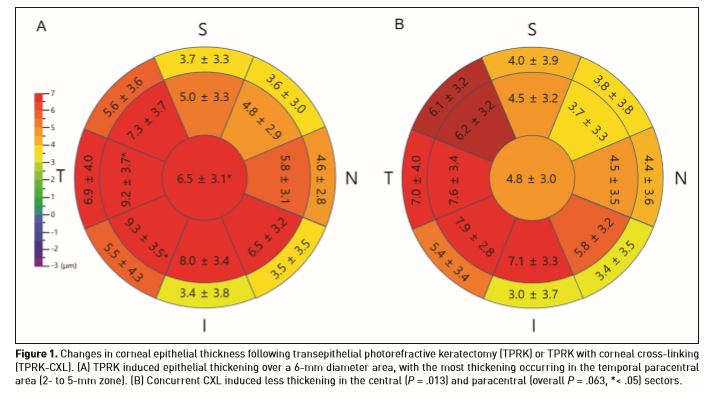
Figure 1. Changes in corneal epithelial thickness following transepithelial photorefractive keratectomy (TPRK) or TPRK with corneal cross-linking (TPRK-CXL).
Chart A: TPRK induced epithelial thickening (μm)
Zone Superior (S) Nasal (N) Inferior (I) Temporal (T) Central Outer (5-6mm) 3.7 ± 3.3 4.6 ± 2.8 3.4 ± 3.8 5.6 ± 3.6 Paracentral (2-5mm) 5.0 ± 3.3 (S), 4.8 ± 2.9 (SN) 5.8 ± 3.1 (N), 6.5 ± 3.2 (IN) 8.0 ± 3.4 (I), 9.3 ± 3.5* (IT) 9.2 ± 3.7* (T), 7.3 ± 3.7 (ST) Central (0-2mm) 6.9 ± 4.0 6.5 ± 3.1* Chart B: Concurrent CXL induced thickening (μm)
Zone Superior (S) Nasal (N) Inferior (I) Temporal (T) Central Outer (5-6mm) 4.0 ± 3.9 4.4 ± 3.6 3.0 ± 3.7 6.1 ± 3.2 Paracentral (2-5mm) 4.5 ± 3.2 (S), 3.7 ± 3.3 (SN) 4.5 ± 3.5 (N), 5.8 ± 3.2 (IN) 7.1 ± 3.3 (I), 5.4 ± 3.4 (IT) 7.6 ± 3.4 (T), 6.2 ± 3.2 (ST) Central (0-2mm) 7.0 ± 4.0 4.8 ± 3.0
With the new findings, we will provide you with safer eye correction surgery.