[Paper] Optimized artificial intelligence for enhances ectasia detection using scheimpflug-based corneal tomography and biomecanical data
2023.03.14 2524
An artificial intelligence (AI) algorithm for identifying keratoconus was published in December in the SCI journal, 'American Journal of Ophthalmology' (AJO).
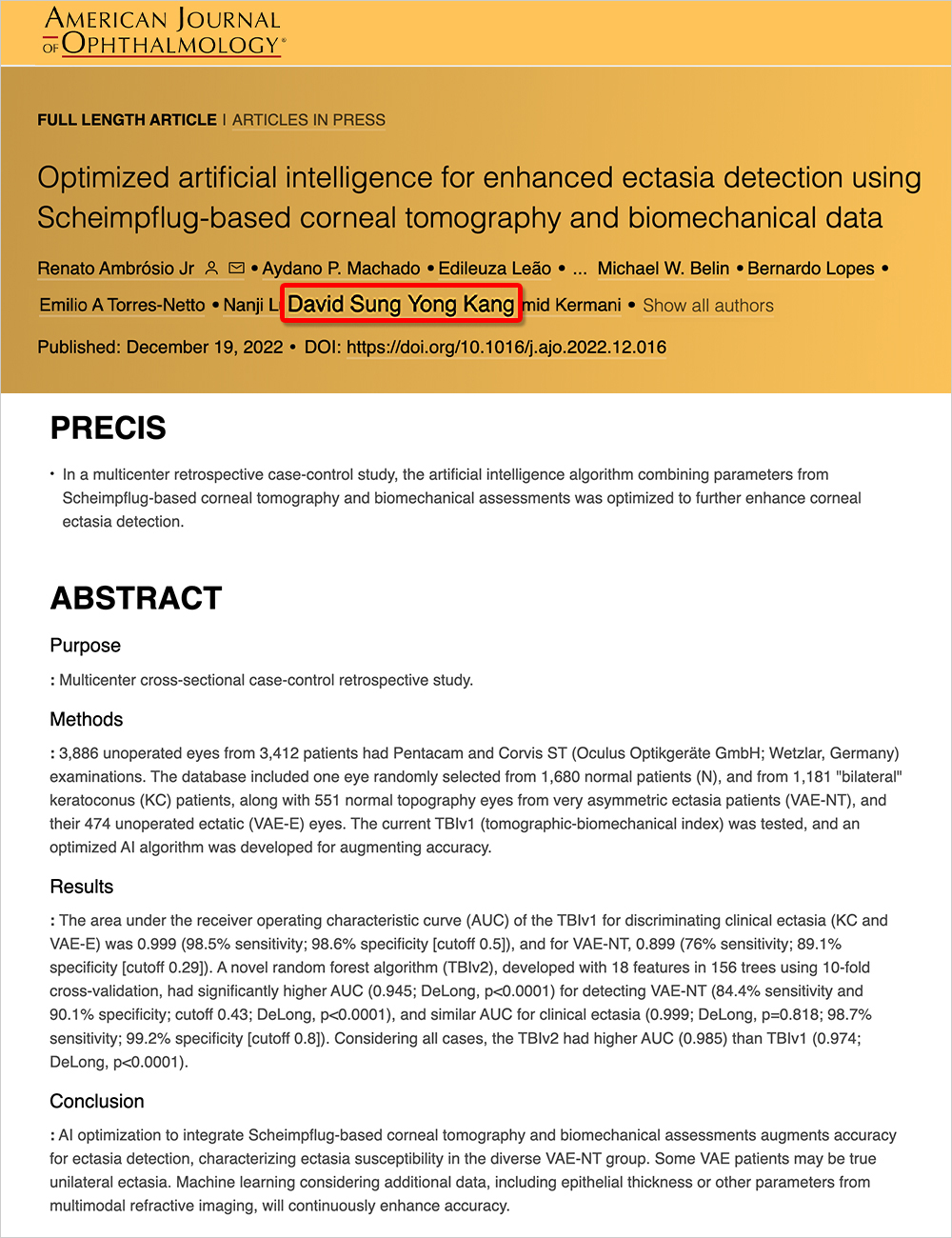
AMERICAN JOURNAL OF OPHTHALMOLOGY
FULL LENGTH ARTICLE | ARTICLES IN PRESS
Optimized artificial intelligence for enhanced ectasia detection using Scheimpflug-based corneal tomography and biomechanical data
Renato Ambrósio Jr • Aydano P. Machado • Edileuza Leão • ... Michael W. Belin • Bernardo Lopes • Emilio A Torres-Netto • Nanji L • David Sung Yong Kang • Hamid Kermani • Show all authors
Published
December 19, 2022
DOI
https://doi.org/10.1016/j.ajo.2022.12.016
PRECIS
In a multicenter retrospective case-control study, the artificial intelligence algorithm combining parameters from Scheimpflug-based corneal tomography and biomechanical assessments was optimized to further enhance corneal ectasia detection.
3,886 unoperated eyes from 3,412 patients had Pentacam and Corvis ST (Oculus Optikgeräte GmbH; Wetzlar, Germany) examinations. The database included one eye randomly selected from 1,680 normal patients (N), and from 1,181 "bilateral" keratoconus (KC) patients, along with 551 normal topography eyes from very asymmetric ectasia patients (VAE-NT), and their 474 unoperated ectatic (VAE-E) eyes. The current TBIv1 (tomographic-biomechanical index) was tested, and an optimized AI algorithm was developed for augmenting accuracy.
Results
The area under the receiver operating characteristic curve (AUC) of the TBIv1 for discriminating clinical ectasia (KC and VAE-E) was 0.999 (98.5% sensitivity; 98.6% specificity [cutoff 0.5]), and for VAE-NT, 0.899 (76% sensitivity; 89.1% specificity [cutoff 0.29]). A novel random forest algorithm (TBIv2), developed with 18 features in 156 trees using 10-fold cross-validation, had significantly higher AUC (0.945; DeLong, p<0.0001) for detecting VAE-NT (84.4% sensitivity and 90.1% specificity; cutoff 0.43; DeLong, p<0.0001), and similar AUC for clinical ectasia (0.999; DeLong, p=0.818; 98.7% sensitivity; 99.2% specificity [cutoff 0.8]). Considering all cases, the TBIv2 had higher AUC (0.985) than TBIv1 (0.974; DeLong, p<0.0001).
Conclusion
AI optimization to integrate Scheimpflug-based corneal tomography and biomechanical assessments augments accuracy for ectasia detection, characterizing ectasia susceptibility in the diverse VAE-NT group. Some VAE patients may be true unilateral ectasia. Machine learning considering additional data, including epithelial thickness or other parameters from multimodal refractive imaging, will continuously enhance accuracy.
52 ophthalmologists from 14 countries in Europe, North America, and Asia, including Korea(Dr. Sung-Yong Kang at EYEREUM EYE CLINIC), have collaborated to develop an AI algorithm (TBI v2) that improves the accuracy of ectasia identification using the tomographic-biomechanical index (TBI).
It is significant to improve the accuracy of keratoconus diagnosis, which characterizes the sensitivity of ectasia(keratoconus) in various asymmetric corneal groups.