NOTICE & NEWS
EYEREUM OPHTHALMIC CLINIC
ESCRS 37TH CONGRESS OF THE ESCRS PARIS
OCULUS - PENTACAM Holladay Report
Reducing Higher-Order Aberrations in KLEx through Asymmetric Laser Spacing(JCRS)
EYEREUM EYE CLINIC has scientifically demonstrated a novel laser pattern technique that further advances surgical outcomes in Keratorefractive Lenticule Extraction (KLEx) through a global collaborative research project conducted with researchers from Yonsei University and Germany.
This study has been published in the internationally renowned SCI-indexed journal,
Journal of Cataract & Refractive Surgery (JCRS), one of the most authoritative journals in the fields of cataract and refractive surgery.
This publication marks EYEREUM EYE CLINIC’s 65th SCI paper, reflecting its continued commitment to academic research and evidence-based clinical innovation.
Park, Ella (SeoYeon) MD¹*; Kim, Kangyoon MD¹,²*; Arba-Mosquera, Samuel PhD³; Kim, Tae-im MD, PhD¹,⁴,⁵; Yong Kang, David Sung MD²,³ Author Information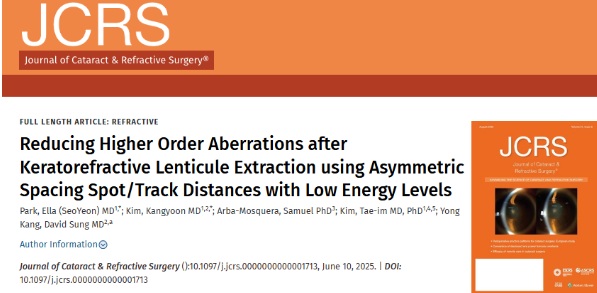
JCRS Journal of Cataract & Refractive Surgery®
FULL LENGTH ARTICLE: REFRACTIVE
Reducing Higher Order Aberrations after Keratorefractive Lenticule Extraction using Asymmetric Spacing Spot/Track Distances with Low Energy Levels
●Study Overview
The study investigates a method to reduce higher-order aberrations (HOAs) in KLEx by applying
asymmetric laser spacing (spot and track distances) at low energy levels.
Original Article Title:
Reducing Higher Order Aberrations after Keratorefractive Lenticule Extraction using Asymmetric Spacing Spot/Track Distances with Low Energy Levels
●Key Findings
Instead of the conventional symmetric laser irradiation pattern, the study applied an asymmetric laser arrangement.
The results demonstrated that while uncorrected and corrected visual acuity were maintained, the following optical aberrations were significantly reduced:
ㆍTotal higher-order aberrations (HOAs)
ㆍComa aberration
ㆍSpherical aberration
These findings confirm that subtle but precise technical modifications in laser pattern design can lead to meaningful improvements in visual quality after KLEx surgery.
EYEREUM EYE CLINIC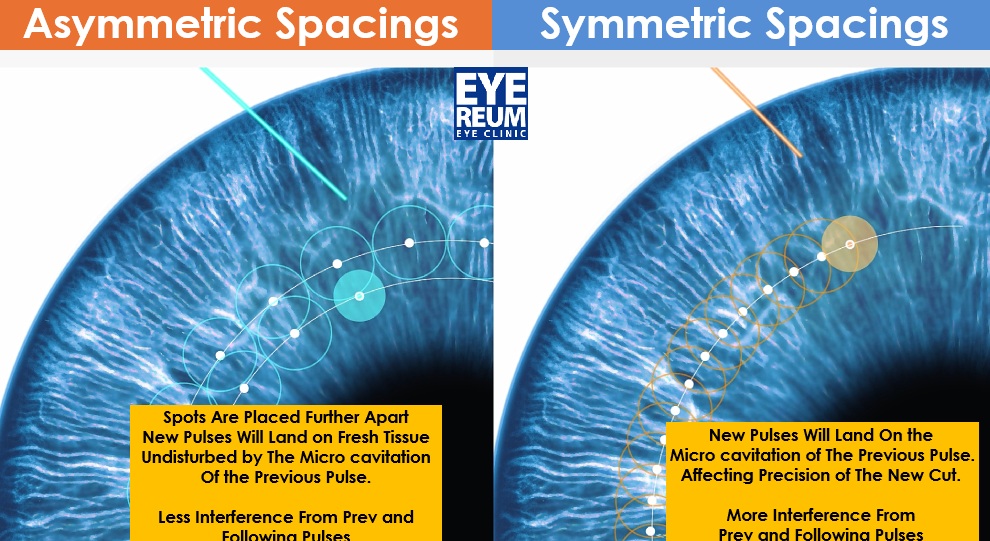
Category Description Effect Asymmetric Spacings Spots Are Placed Further Apart New Pulses Will Land on Fresh Tissue Undisturbed by The Micro cavitation Of the Previous Pulse. Less Interference From Prev and Following Pulses Symmetric Spacings New Pulses Will Land On the Micro cavitation of The Previous Pulse. Affecting Precision of The New Cut. More Interference From Prev and Following Pulses
“Small technical differences create significant clinical outcomes.”
This study highlights how meticulous refinement of surgical parameters—supported by scientific evidence—can elevate refractive surgery results beyond conventional standards.
EYEREUM EYE CLINIC will continue to contribute to global ophthalmic research through collaborative studies and ongoing innovation, with the goal of improving long-term visual quality and patient outcomes.


